Remember the hype about blockchain-based data capture that could keep track of a watch throughout its lifetime?
Various pilot projects from the likes of Vacheron Constantin, which registered details of its Les Collectionneurs collection in 2020, appear to have stalled.
We hear little these days from the likes of Omega, Breitling, Louis Erard, Dubois et Fils, Panerai and Ressence, which have all experimented with blockchain-based authentication and tracking, but the challenge of instantly identifying whether a watch is genuine or fake, and gleaning information like who has bought and sold it, remains.
No brand needs a solution to track information about its watches and customers more than Rolex.
Rolex makes the most traded watches in the world, they are also the most frequently stolen and the most counterfeited by criminal gangs, so considerable investment has gone into finding a solution to protect its watches, its customers and its reputation.
A patent application filed with the Organisation Mondiale de la Propriété Intellectuelle in August shows details of a potential solution from Rolex.
The application shows an integrated solution that includes an NFT chip and smartphone app that stores data about a person, a watch and a security key.
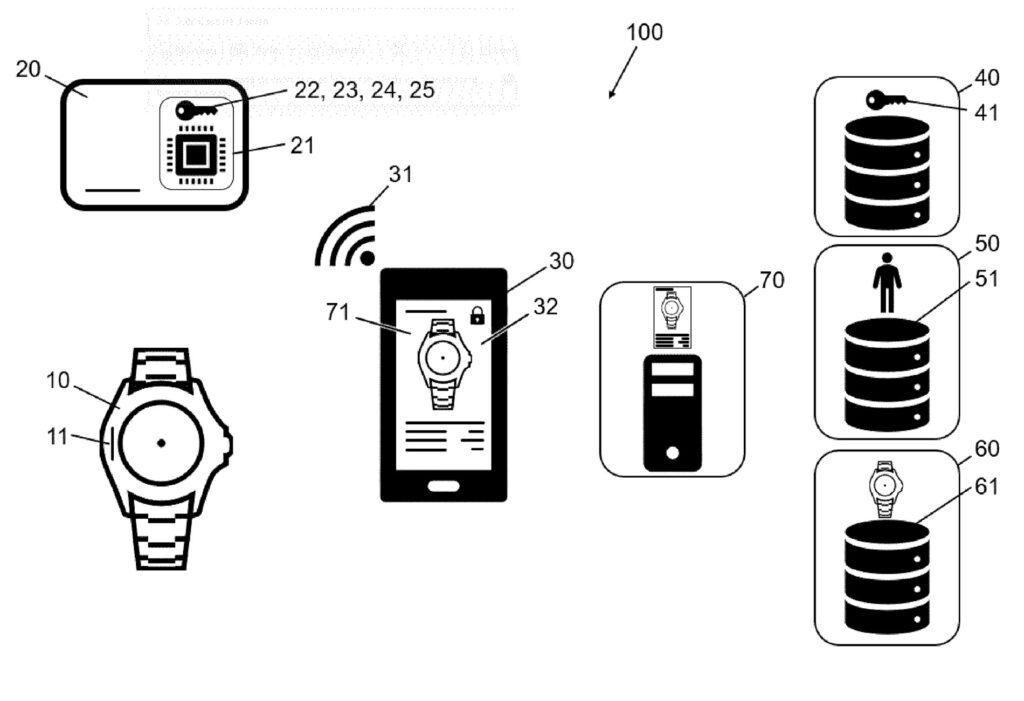
According to the patent application, Rolex is looking to protect a computerised method for storing and managing data associated with a timepiece belonging to a user.
The application describes how it might improve customers’ experience in practice: “When a user drops off a watch at a retailer for maintenance, it is essential that the user can communicate with the retailer, in particular to agree on quotes and/or actions to be planned on the watch. These communications are generally made via emails, faxes or telephone calls. These means of communication are now significantly outdated compared to the possibilities offered by new technologies,” the patent filing says.
“In addition, these means of communication are not secure or are poorly secured. In particular, these means do not reliably ensure that communications are exchanged with the real user of the watch. Consequently, the protection of the user’s personal data may be compromised,” it adds.
The aim of Rolex’s “Watch Certificate” is the same as for brands using blockchain technology, which is to prove the authenticity of a watch, and works in a similar way.
Rolex’s solution allows both retailers and customers to access information via a web page to various specific data of a watch by scanning a card-based chip, similar to a warranty card, using a smartphone camera or QR code.
The chip might include information about the watch, its service history and its owners.
And the data is also securely stored on the incorruptible blockchain.
“The same type of solution using blockchain technology from the “Arianee” consortium is used by other watchmaking players,” Rolex notes.
This solution, Rolex’s patent application says, allows for complete traceability and is intended to prove the authenticity and ownership of a watch.
The solution highlighted in the application is a card linked to a watch and equipped with a QR code. It could alternatively be equipped with an NFC (Near Field Communication) chip.
Once scanned with a smartphone, the card allows the user to access a web page to register their watch and obtain a certificate of authenticity.
To obtain this certificate, the user is invited to connect to a dedicated mobile application to generate a certificate in an NFT (Non-Fungible Token) format, and declare themselves as the first owner.