
There is a sharp contrast between the financial results of Richemont’s watch brands and those of Japanese watchmakers, Citizen Watch Company, Casio and Seiko Corporation for the past financial year.
Combined watch sales at Richemont’s specialist watchmakers division are down 4% in reported terms (although up 1% at constant exchange rates).
This compares with growth last year of 12% for the combined sales of Japan’s big three watchmakers.
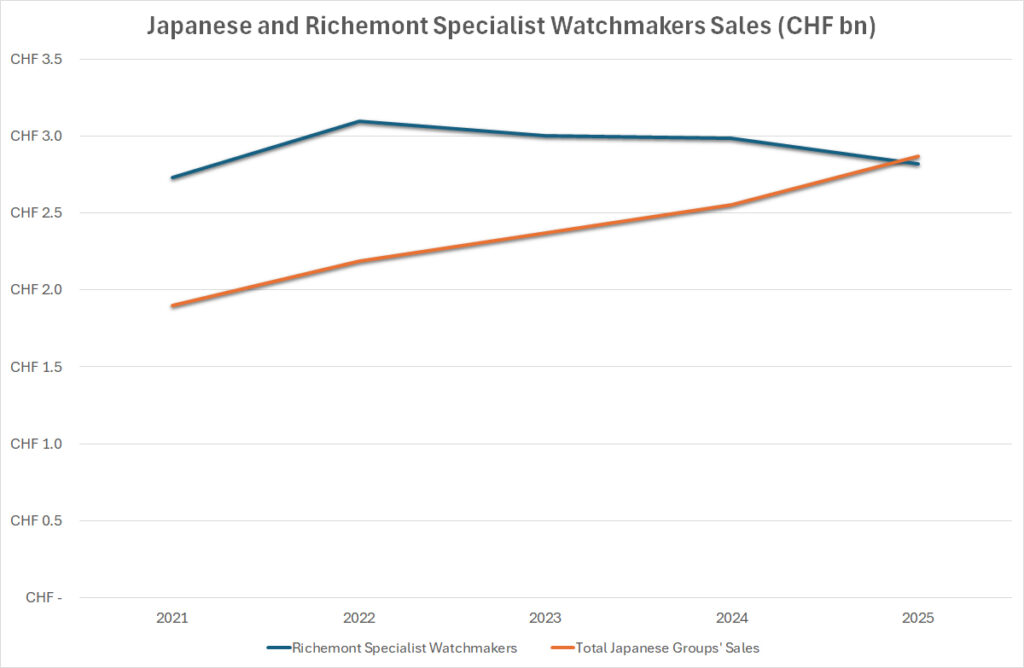
Remarkably, Japan’s manufacturers now generate more in sales than the aggregated turnover of Vacheron Constantin, IWC, Jaeger-LeCoultre, Panerai, Piaget, A. Lange & Söhne, Roger Dubuis and Baume & Mercier.
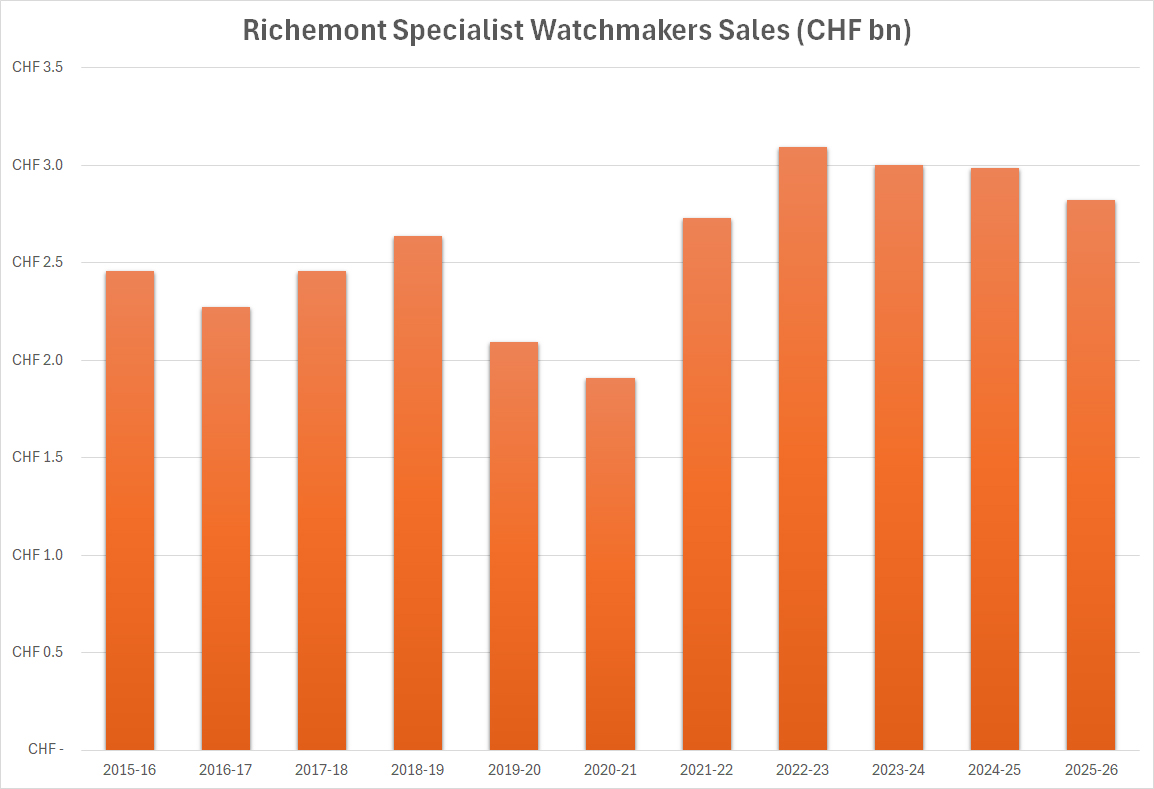
As recently as 2021, Richemont’s watchmakers generated CHF 700 million more in sales than the Swiss.
Now they are neck and neck.
This is a comparison between apples and oranges, you might suggest; or between cod and caviar.
It is neither enlightening nor fair to judge the performance of Japan’s mass-produced watches with Swiss timepieces commanding five- or even six-figure prices for their artisanally-finished high precision mechanical masterpieces.
I don’t entirely agree. They are all competing for disposable income and for the same wrists.
Japanese watchmakers versus Swiss volume manufacturers
However, to get a closer comparison, I looked at a handful of lower priced, higher volume Swiss watchmakers to see if they performed more favourably against their Japanese rivals.
Groups like Richemont and Swatch Group do not break down sales by individual brand, so the following analysis compares data from the financial reports of the Japanese with estimates from Morgan Stanley and LuxeConsult’s annual reports on the state of the Swiss watch industry.
There is also a difference in the reporting periods. Morgan Stanley’s estimates are for January to December calendar years, Japanese results are for their financial years, which run from April to March.
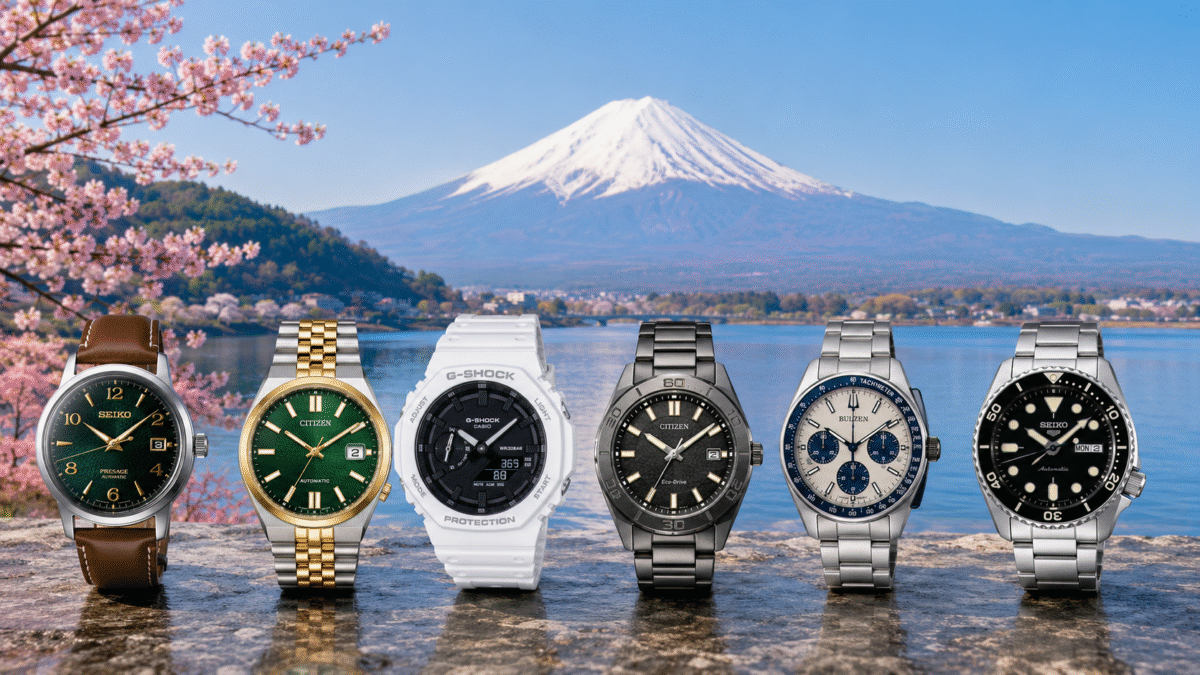
Japan’s collective turnover comes from the likes of Seiko and Grand Seiko; Citizen and Frederique Constant; G-Shock and Casio. I have chosen to compare their results to those of Baume & Mercier, Longines, Tissot, Swatch and TAG Heuer.
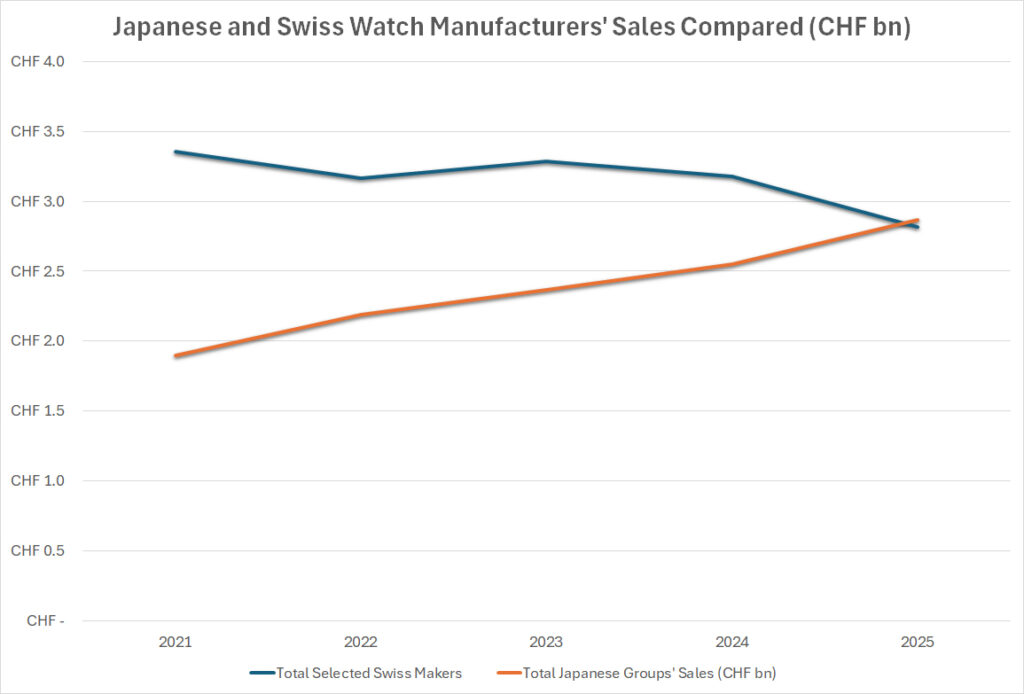
The reversal in fortunes between Swiss and Japanese manufactures is even more pronounced in this comparison.
As recently as 2021, the selected Swiss watchmakers outsold Japan’s by almost two to one. That gap has disappeared completely.
Within the selection of Swiss marques, Longines (down from CHF 1.5 billion to CHF 0.9 billion) and Tissot (CHF 0.9 billion to CHF 0.7 billion) are by far the biggest losers.
TAG Heuer sales are flat at CHF 0.7 billion per year and Baume & Mercier’s have not dropped much from around CHF 60 million.
The biggest Swiss manufacturer by volume, Swatch, has more than doubled sales over the five year period, thanks to the success of its MoonSwatch.
Swatch Group says the Morgan Stanley estimates are wildly inaccurate, without elaborating or providing their own brand-by-brand results, but its group revenue is a matter of public record and has been declining since 2022.
Of course, the battle for every wrist has a newer, even more consequential interloper: Apple.
| Year | Estimated Units Sold | Estimated Revenue (USD bn) | Estimated Revenue (CHF bn) |
|---|---|---|---|
| 2021 | 45–50 million | ~$21–23bn | ~CHF 19–21bn |
| 2022 | ~54 million | ~$25–27bn | ~CHF 23–25bn |
| 2023 | ~38 million | ~$18–19bn | ~CHF 16–17bn |
| 2024 | ~31–33 million | ~$15–16bn | ~CHF 13–14bn |
| 2025 | ~35–38 million | ~$17–19bn | ~CHF 15–17bn |
The tech giant does not publish precise financial data on its Apple Watch, but there is a settled view among analysts showing sales peaked in 2022 at around CHF 23 to CHF 25 billion (at today’s exchange rates). This had dropped by around one-third by 2025.
There was a time when Swiss manufacturers were congratulating themselves for holding their nerve in the face of the smartwatch onslaught.
Apple and Samsung were helping the world appreciate telling the time by looking at a wristwatch, a habit younger generations had lost during the rise of time-telling smartphones.
The Swiss suggested that, as this cohort aged and became richer, smartwatch wearers graduated to something analogue, beautiful and with more status-signalling.
Rolex, in particular, does appear to be a beneficiary of this phenomenon, but far too many Swiss luxury brands lack The Crown’s instant recognition and appeal.
Price, or at least value for money, is the problem for the Swiss. Spending $10,000 on a first Rolex is a massive step-up from a $500 smartwatch, but it is still a leap to which millions of people aspire. Having established their status with a Rolex, a proportion of them continue their horological journey towards Audemars Piguet, Patek Philippe or elsewhere.
Tissot, Longines and TAG Heuer need to remain a part of this journey, either as a first Swiss watch alternative to Rolex, or as a stepping stone to the more expensive brands.
This is where the Japanese are winning. They provide a path from smart or quartz watches costing a few hundred bucks to something mechanical for well under $1,000.
And they are nibbling their way north to even higher price points through the likes of The Citizen, Grand Seiko, Frederique Constant and top end Seikos and G-Shocks.
For now, Swiss businesses are sticking to their premiumisation strategy: accept the world is buying fewer of its watches, but compensate with higher prices.
Every year that passes since sales peaked in 2022, this strategy looks less defensible and more in need of “something to turn up”: a Chinese rebound being the most widely cited.
I believe something more radical is required, and an honest assessment of what is driving Japanese success would be a good starting point.